Choosing a level 2 method book is the second most important repertoire decision you will make!
The most important decision is obviously choosing a student’s first piano book. But, after that, the level 2 method book is the one that will make or break your studio.
In today’s post, we are looking at why the level 2 method book is so important and then sharing an in-depth teacher’s guide for the WunderKeys Elementary Piano Level 2 series.
A Teacher’s Guide To WunderKeys Elementary Piano Level 2
Elementary piano level 2 method books represent the bridge between music for “kids” and music for intermediate teens.
And if that bridge isn’t pedagogically sound, kids aren’t going to cross it. Instead, they will get frustrated or bored and quit piano lessons.
Trevor and I created our WunderKeys Elementary Piano Level 2 books with two things in mind: 1. They must appeal to the tastes of today’s children, and 2. They must be pedagogically perfect.
We did not compromise on either of these two points. A rockin’ song that does not build on a student’s current skills or develop them in a pedagogically appropriate manner is detrimental to development. Similarly, a pedagogically perfect song that is brutally boring can be just as dangerous.
In our elementary piano level 2 method books, we’ve found the balance that will thrill your piano students.
WunderKeys Elementary Piano Level 2 is divided into a lesson book 2A and a lesson book 2B.
Let’s Look At Lesson Book 2A
WunderKeys Elementary Piano Lesson Book 2A is about to become the most important book in your studio library.
The fact is, many kids quit piano when they reach level 2 method books because they are too old for “little kid” music and too young for “cool teen” music.
So we said to ourselves, “That’s silly, let’s create a pop-infused level 2 method book that develops students into modern piano players with the technical prowess of classically-trained pianists.”
WunderKeys Elementary Piano Level 2A explores the G Major and G Minor 5-Finger Scales, the D Major and D Minor 5-Finger Scales, and the A Major and A Minor 5-Finger Scales as well as eighth rests, dotted eighth note rhythms, pick-up bars, and left-hand patterns through repertoire, duets, technical exercises, sight-reading activities, and improv. Your students will also get to explore technique in this book including pedaling, phrasing, and hand balance.
Click here or on the image below to buy Lesson Book 2A on Amazon.

What Your Piano Students Will Learn in 2A:
Five-Finger Scales: G major, G minor, D major, D minor, A major, A minor (bass, middle, and treble)
Note Reading: all grand staff notes plus ledger line notes including high G and A, middle (treble) A and B, and middle (bass) D and E
Rhythm: eighth notes, quarter notes, dotted quarter notes, half notes, and whole notes and their rest value equivalents, and pick-up bars or upbeats
Intervals: 2nd, 3rd, 4th, 5th
Time Signatures: 3/4 and 4/4
Accompaniment Patterns: repeating half notes, broken fifths with quarter notes, broken triads
Additional Skills: phrasing, pedalling, hand balance, staccato, legato, ritardando, crescendo, diminuendo, first and second endings, fermata, 8va and 8vb
Listen To Audio Samples:
Let’s Look At Lesson Book 2B
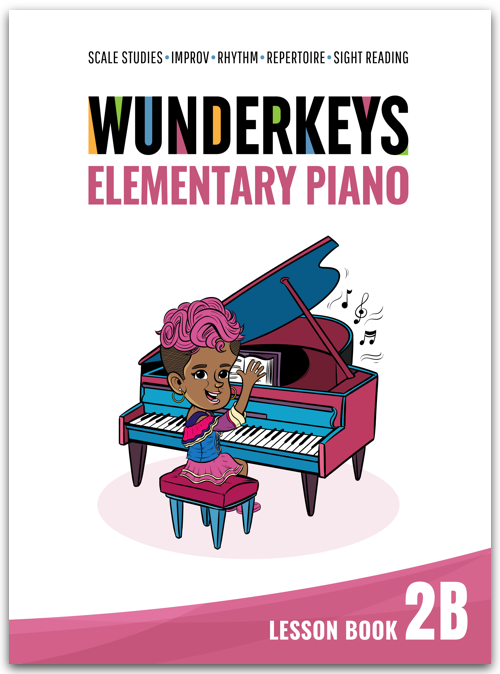
In WunderKeys Elementary Piano Lesson Book 2B, students break free from 5-finger positions and explore the magic of one-octave scales.
With access to new notes, new intervals, and new chords, Lesson Book 2B feels like it is light years away from “little kid” music. Anyone listening to a student perform from this resource will hear a bonafide piano player.
Jam-packed with pop-infused piano studies, technical exercises, left-hand patterns, improvisation, sight reading, chord exploration, rhythm work, and classical-inspired pop repertoire, this book provides level 2 students with exactly what they want and need: super cool, peer-approved music that is developmentally appropriate and perfectly paced.
WunderKeys Elementary Piano Lesson Book 2B is available on Amazon.
What Your Piano Students Will Learn in 2B:
One-Octave Scales: C major, Treble C major, G major, D minor, Treble D minor
Key Signatures: G major, D minor
Note Reading: all grand staff notes plus ledger line notes, including high G, A, B, C, D, middle (treble) A and B, and middle (bass) D and E
Rhythm: eighth notes, quarter notes, dotted quarter notes, half notes, and whole notes and their rest value equivalents, pick-up bars or upbeats, rhythms in 6/8 time
Intervals: 2nd, 3rd, 4th, 5th, 6th
Primary Pop Chords: I, IV, V
Time Signatures: 3/4, 4/4, 6/8
Accompaniment Patterns: broken fifths, waltz pattern, held fifths with repeating thumb
Additional Skills: simile, da capo al coda, grace notes, natural signs, pedalling, staccato, legato, ritardando, crescendo, diminuendo, first and second endings, fermata, 8va and 8vb