The piano world can be one that is resistant to change. Fortunately, this is not the world that Trevor and I live in.
We are so grateful for the teachers in the WunderKeys and Teach Piano Today community who fully embrace change.
And I believe our community embraces change because they know that we compose music in a way that respects and pays homage to classical music.
When we write music or method books, we do so in a way that meets the needs of modern students, while building a bridge to classical music.
Nothing illustrates our philosophy better than our inclusion of pop chords in our method books and supplementary repertoire.
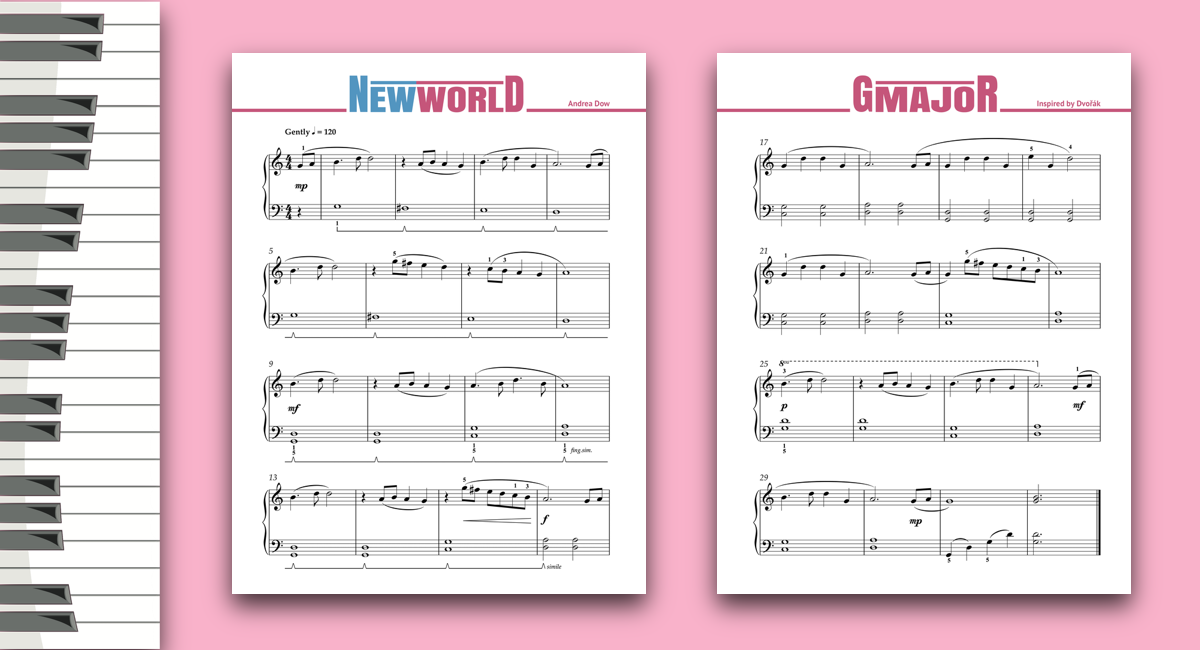
In today’s post, we’re sharing a Pop Chord Piano Solo infused with the New World Symphony by Dvořák.
Let’s Get Serious About Pop Chords
When kids begin playing chords in most method books, they learn the I and V7 chords in a key. That’s not exactly our approach in WunderKeys. Instead, we begin by teaching kids the I, IV, and V pop chords played as harmonic 5ths.
The Problem With Classical I And V7 Chords
Kids are not as old as one might think when they reach a level 2 method book. They are often nine and ten years old, with some even starting as young as eight. For these kids, classical I and V7 chords present problems with coordination and theoretical understanding.
Let’s begin with the coordination factor. While the I chord doesn’t usually present too many problems, the issue begins with the V7 chord which is typically introduced in inversion. It includes a leading tone played with the five finger. In the key of C major, this requires a stretch that most students can handle. But in the keys of G major or D minor, not only is that pinky stretching, but it is reaching for a black key.
This is why many method books will often have kids play a modified V7 where only the top two notes are used.
The second issue revolves around theory. The V7 chord commonly introduced in most method books is actually an inversion of a V7 chord, instead of the root. This gets confusing when kids are told that chords are named for their root, and then one of the first chords they learn does not follow this pattern and they have not yet encountered chord inversions.
To some, this may seem like a minor issue, but I consider it a larger problem. When kids are first introduced to chords, just like any new music concept, things must make sense. And when they don’t make sense, kids will begin to feel inadequate. This inadequacy then bleeds over to other areas of the piano lesson.
Finally, and most importantly, I and V7 chords just don’t sound that cool. Kids in a level 2 method book are not connoisseurs of classical music. If we can keep them in piano lessons, one day they will be. But for now, most are not particularly fond of the sounds that I and V7 chords create.
They need chords that will build the bridge to classical music… they need pop chords.
Solving Problems With Pop Chords
In WunderKeys Elementary Piano Lesson Book 2B we introduce students to the I, IV, and V pop chords played as harmonic 5ths.
In G major, for example, the pop chords are G major, C major, and D major. Introducing kids to pop chords played as harmonic 5ths has many benefits…
1. Theory Is Simplified
Chords in root position are named for the root of the chord. When kids learn to play with pop chords, learning to name them is a snap. They easily understand the chord’s relationship to the key, they are building early transposition skills and they do not have to get bogged down with the theory behind V7 chords played in inversion.
2. An Early Introduction To Left-Hand Movement
In classical-style method books, playing I and V7 chords requires very little left-hand movement. While this may seem advantageous, it comes with disadvantages. For one, although it requires less left-hand movement than pop chords, the positioning of the left hand to play the V7 chord can be complicated or difficult for small hands.
Pop chords played as harmonic 5ths, on the other hand, keep the same hand structure and move it around the keys. And moving isn’t nearly as difficult as one may think. Kids simply landmark the root note, find the matching key, and then play a harmonic 5th based on that key.
And this moving around the keys is where pop chords really shine. As you know, when kids move on to level 3 method books, they begin playing waltz patterns, broken chord patterns, and arpeggios. These left-hand patterns nearly always require a student to move the left hand around the piano.
If kids have not had the friendly and early introduction to frequent left-hand movement provided by pop chords, they get overwhelmed during a time when they are very likely to simply quit lessons.
And, of course, our goal is to create lifelong piano students.
3. Pop Chords Sound Cool
Put quite simply, pop chords sound much cooler to kids than classical chords. Kids are used to the pop sounds that I, IV and V chord movement produces. And kids at this age of their development really want to play music that sounds cool. That’s why we use pop chords to build the bridge to classical music.
Before You Download Today’s Printable
Today’s sheet music is available to download at the bottom of the post, but first…
Have you checked out WunderKeys Elementary Piano Lesson Book 2B.
Jam-packed with pop-infused piano studies, technical exercises, left-hand patterns, improvisation, sight reading, chord exploration, rhythm work, and classical-inspired pop repertoire, this book provides level 2 students with exactly what they want and need: super cool, peer-approved music that is developmentally appropriate and perfectly paced.
Before you download today’s piano solo, click here or on the cover below to buy WunderKeys 2B today!

Download This Solo And Put Pop Chords To Work
Today’s Pop Chord Piano Solo is inspired by Dvorak’s New World Symphony. If you want to witness the power of pop chords first hand, give this piece to a tween or teen piano student.
Click here or on the image below to download the sheet music.